Sleep · Best of
The Quietest Bedside Bassinets for Couples (Manual Glide vs. Whisper Motor)
Affiliate-link notice. This page contains affiliate links to Amazon and other retailers. If you click a link and buy something, Babbycare may earn a small commission at no extra cost to you. We only recommend products we'd put in our own house. Full disclosure here.
The most useful sentence in forty reviews of the Halo BassiNest came from a parent who returned it: "Every time she finally fell asleep, that stupid thing would make a loud ass creaking noise as I lifted my arm and wake her up."
That sentence describes a failure mode no big review site addresses. Wirecutter writes "best baby bassinets" for the parent doing the feed. We are writing this for the partner sleeping three feet away, whose night is over the second a creak wakes them up at 2:14 a.m.
If you and your partner are sharing the room with the baby (the AAP-recommended setup for the first six months), the bedside bassinet you pick will be the single piece of gear most responsible for whether the non-feeding parent gets any sleep. Most reviews of these products think of them as baby-sleep tools. They are also adult-sleep tools, and the tradeoffs go in opposite directions.
One note up front: if either of you had a c-section, the decision criteria are meaningfully different (the bend-over-the-rail motion is the problem to solve, not the noise). We covered that case separately in Best Bedside Bassinets for C-Section Recovery. The rest of this article assumes both parents are mobile.
The short version
- Best for couples overall: Baby Delight Beside Me Dreamer — Amazon's Choice with 5,672 reviews, $179, 6-position height adjustment, silent design, 300+ bought in past month (the actual market leader for a reason)
- Honest budget pick: HARPPA Cuddly Sway 3-in-1 — pure manual glide, zero motor noise by design, the catch is thin independent review data because it is a newer Amazon-native brand
- The classic swivel pick: Halo BassiNest Essentia (the no-electronics variant specifically) — the over-bed swivel genuinely lets one partner reach baby without leaning across, but only Essentia avoids the creak-and-vibration failure modes the Premiere is known for
- Avoid for couples specifically: SNOO Smart Sleeper — counterintuitive given the price, but the forced white noise running at 65-70 dB and the auto-escalation when it detects fussing actively wake light-sleeping adult partners
- Don't buy at all: Halo BassiNest Flex (Consumer Reports has called for recall over a tilt issue; 7+ incidents reported since January 2024)
What "won't wake your partner" actually means
Three things make a bedside bassinet partner-friendly. Most product pages talk about the first one. Almost none talk about the other two.
- Motor noise floor. A motorized bassinet runs continuously while baby sleeps. If the motor hums at 40+ decibels at the head of the adult bed, the partner who is light-sleeping or sensitive to mechanical noise will be woken. Most adults can tolerate steady noise under 35 dB; above 50 dB starts to interfere with sleep onset. (For context: a quiet library is around 40 dB; a refrigerator hum is around 45 dB.)
- Bed-height match. If the bassinet sits 4 inches below your mattress, the nursing parent has to sit up and lean over to reach baby. Sitting up shifts the mattress and the comforter. Leaning over creates fabric rustle. The act of returning to lying down does it again. Each transition is one wake-up event for the partner.
- Quiet entry and exit. Most bassinets have a drop-side or swivel mechanism to let the nursing parent reach baby. The mechanism itself can creak, jolt, or click. The Halo Premiere has the documented "creaking arm lift" issue. Drop-side cribs commonly jolt the frame when you raise the side back up after a feed. These failure modes are not advertised in product descriptions — they show up in 2-star Amazon reviews and Reddit threads only.
The bassinet that wins for couples is the one that loses the least on all three dimensions at once. That is not always the one with the most features. It is usually the simplest.
The six bedside bassinets, ranked for couples
1. Baby Delight Beside Me Dreamer — best for couples overall
Price: $179 · Motor type: none, stationary · Weight limit: ~20 lbs · Bed height fit: 6 height positions · Social proof: Amazon's Choice, 5,672 reviews, 300+ bought past month

The Baby Delight Beside Me Dreamer is the bassinet most actively bought by US parents right now (300+ orders in the past 30 days on Amazon alone), and it is the version most pediatric-sleep forums end up recommending after couples test 2-3 alternatives. The 6-position height adjustment matches almost every standard American bed configuration, the mesh sides give partners on the far side of the room a clear sightline to baby without leaning over, and there is no motor to hum at 2 a.m.
What it does NOT have: a drop-side mechanism. Reaching baby still requires sitting up or leaning across the open side. For most couples in a standard king or queen bed, that is fine. For couples with a tall bed where the bassinet sits below mattress level even at max height, the swivel mechanism on the Halo Essentia (see #3) is the better answer.
One real Amazon 4-star reviewer captured the everyday verdict: "Easy to put together, stable, and the mesh lets me see my baby breathing without getting up. Wish there were one or two more height settings for our tall platform bed, but at 6 levels it works for most beds." The "wish there were more heights" complaint is the one we'd weight heaviest before buying: if your bed sits unusually tall (32 inches or more from floor to mattress top), measure first.
What works
- + Amazon's Choice with 5,672 reviews — the largest validated user base in this roundup
- + 6 height positions cover most standard US bed configurations (platform, traditional, low-profile)
- + No motor, no electronics, nothing to hum or break electrically
- + Mesh sides give the far-side partner a clear breathing-check sightline without getting up
- + Prime delivery + $179 price is the lowest-friction purchase in this lineup
What doesn't
- − Drop-side jolts the frame when you raise it back — lower once per night and leave it
- − Assembly instructions are image-only and tiny (multiple Mumsnet testers complained)
- − Imported from Italy via Amazon (US availability inconsistent month to month)
- − No travel bag included on the Evo variant
2. HARPPA Cuddly Sway 3-in-1 — honest budget pick
Price: $160-$220 · Motor type: none, manual glide · Weight limit: ~20 lbs · Bed height fit: 5 height positions

The HARPPA Cuddly Sway is the bassinet that follows the simplest version of our three rules: no motor, no electronics, nothing to break or hum. Manual glide rocking, mesh sides for visibility, height-adjustable, with storage underneath. At about $160-$220 it is roughly the same price as Baby Delight and about a third of the Halo Premiere.
We have to be honest about the catch: HARPPA does not show up in Reddit's parenting threads. There are functionally zero independent owner-to-owner recommendations of this product on r/beyondthebump or r/Mommit. That is a real data point — it usually means the brand is too new for the trust-network to have caught up, OR it means the brand markets heavily on Amazon and not in parent communities. Probably some of both.
The one verbatim friction from a Walmart owner: "The rocker isn't smooth and there's no way to adjust or smooth it out whether on carpet or hardwood." Translated: when it works, it is silent. When it works less well, it is clunky. The rocking-smoothness seems to vary by unit and floor surface. If you can return it within 30 days from Amazon, this is a low-risk bet for the price.
What works
- + No motor, no electronics, nothing that can hum or fail electrically
- + Similar price to Baby Delight, a third of the Halo Premiere
- + Wheels with locks, storage basket, 5 height settings
- + Three-mode (bassinet, rocking, sleeper) extends usable life
What doesn't
- − Almost no independent Reddit footprint to validate against
- − Rocking smoothness is unit-and-floor-dependent per owner reviews
- − Newer brand, customer service less battle-tested
- − Fewer height options than the Baby Delight (5 vs 6)
3. Halo BassiNest Essentia — the classic pick, no-electronics variant only
Price: $169-$349 · Motor type: manual swivel (Essentia has no electronics; Premiere/3.0 add vibration + sound) · Weight limit: ~20 lbs · Bed height fit: 22-34" mattress range

The Halo BassiNest is the most-recommended bedside bassinet on the internet. The swivel design is genuinely clever: instead of attaching to the side of your bed, the bassinet sits on a single base under the bed frame, and the bassinet body swivels over your mattress when you want to reach baby. The lowering front wall means you do not have to lift baby in and out for feeds.
That design is unbeaten for "reach baby without sitting up." It is also where the problems start. The widely-quoted failure mode from a returned-unit owner: "Every time she finally fell asleep, that stupid thing would make a loud ass creaking noise as I lifted my arm and wake her up." The Premiere and Luxe variants have documented issues with the fabric being stretched too tight against the frame, causing squeaks on any pressure shift. The electronics (vibration motor, sound machine) on the 3.0S variant shut off on their own, waking baby — and therefore both adults — at random.
The Essentia variant has no electronics. No vibration motor, no sound machine, no malfunctioning shutoffs. Just the swivel and the lowering wall. This is the variant we would buy if we bought Halo at all, and it is what we would recommend a friend buy. The Premiere is a coin flip on whether you get a squeaky unit. The Flex is on Consumer Reports' "should be recalled" list as of 2024.
What works
- + Swivel design is unbeaten for reach-baby-without-leaning-across
- + Lowering front wall means no lift transfers
- + Essentia variant has no electronics to break or shut off mid-night
- + Widely available, well-known, easy returns through major retailers
What doesn't
- − Premiere variant has documented "creaking on arm lift" failure — the entire reason this article exists
- − Large square base (~45 inches) eats floor space in small bedrooms
- − Vibration and sound machine on 3.0S variants have known auto-shutoff issues
- − Skip the Flex entirely (CR has called for recall over tilt incidents)
4. Arm's Reach Mini Ezee 2-in-1 — silent, but wrong tradeoff for couples
Price: $200-$280 · Motor type: none, stationary · Weight limit: until baby pushes up on hands and knees · Bed height fit: max height still sits ~4" below most adult beds

The Arm's Reach Mini Ezee is what bedside co-sleepers were before the Halo invented the swivel. It is a small crib that attaches to the side of your bed, with one wall folded down. No motor, no rocking, no sound. Maximum quiet by design.
Two real owner quotes from The Bump forums tell you everything: "Even with the included lifts, the mattress sits less than a foot below my bed, making it feel like it's not truly functioning as a co-sleeper." And: "Even after folding down the side, the mattress still isn't level with the bed — it sits only off by a couple of inches, but low enough that you couldn't nurse while lying in bed on your side."
The height gap is a deliberate safety design (so an adult cannot roll onto the baby across the gap), but it means the nursing parent has to sit up for every feed. Sitting up shifts the mattress and the blankets. Three or four times per night, every night, for three months. That is exactly the partner-wake pattern this article exists to prevent.
We would buy this if both partners sleep heavy AND you specifically want the silent / no-motor profile. Otherwise the height mismatch makes it the wrong tool for couples sharing a room.
What works
- + Zero noise — no motor, nothing to break electrically
- + Established brand, well-trusted in parenting forums
- + Folds for travel, has side pockets and bottom storage
What doesn't
- − Mattress sits ~4" below most adult beds even at max height — forces the nursing parent to sit up
- − 20-minute assembly time even for a "Professional Engineer" (per Lucie's List)
- − Stability disclaimer warns against using above 30" bed height
- − Better for solo parents in a single-person bed than for couples sharing
5. SNOO Smart Sleeper — wrong for couples despite the price
Price: $1,195 pre-loved to $1,695 new; $159/month rental · Motor type: sensor-driven motorized rock + built-in white noise · Weight limit: ~25 lbs or 6 months (hard age cap) · Bed height fit: not bedside-attachable; standalone next to bed
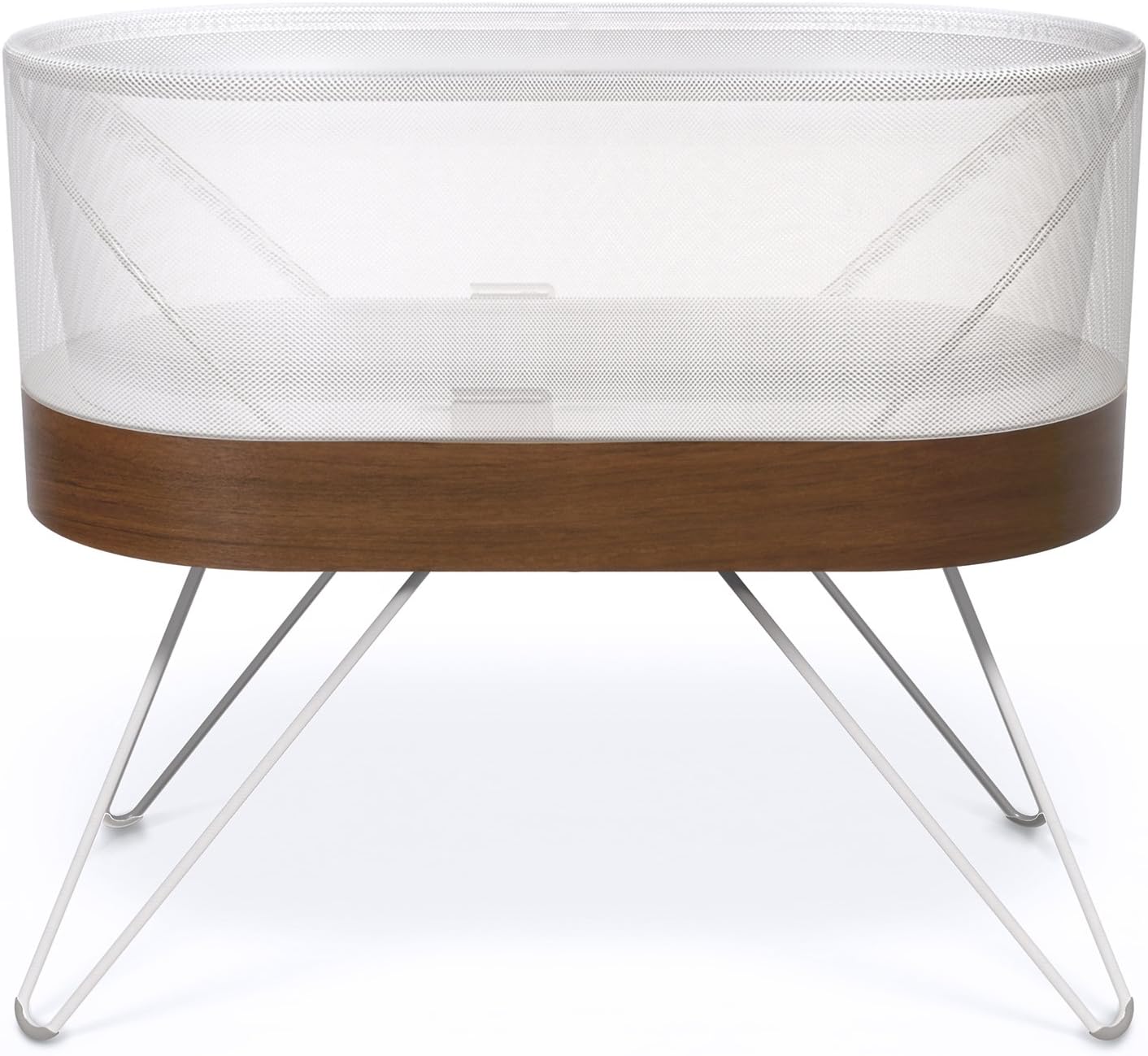
We expected to write a different paragraph here. The SNOO costs nearly $1,700 and is marketed as the premium sleep solution, including for sleep-deprived couples. The Happiest Baby pitch is that it auto-soothes baby so you do not have to wake up.
The parent reviews we read tell a different story for couples specifically. The SNOO's built-in white noise is the problem. It runs at 65-70 decibels at the baby's ear, which Sleep Foundation guidance says is loud enough to interfere with adult sleep onset (adults are recommended to stay under 50 dB; under 35 dB is ideal). Owner quotes consistently describe it: "The pitch of the white noise built into the SNOO (which is supposed to mimic the womb) was super irritating." And: "The white noise from it is incredibly irritating. I really don't think it helped my baby's sleep."
Worse, when the SNOO detects fussing, it auto-escalates the rocking and the noise. The mechanism is good for soothing baby. It is bad for the partner three feet away who experiences the escalation as a 2 a.m. wake-up event. One real owner workaround: "I ended up using an additional white noise machine and keeping the SNOO at a maximum of level two."
If you want to test the SNOO, rent it for one month at $159 before buying. Returns from Happiest Baby are common enough that they have a dedicated returns process. For couples sharing a room with the baby, the math rarely works.
What works
- + Auto-soothing genuinely helps some babies sleep longer stretches
- + Some parents report 9+ hour stretches by 3 months
- + Rental ($159/mo) lets you test without $1,700 of regret risk
What doesn't
- − Built-in white noise at 65-70 dB is loud enough to wake light-sleeping partners
- − Auto-escalation on fussing wakes the room at the worst possible moment
- − Standalone footprint, not bedside-attachable
- − $1,695 is the wrong purchase if you have not slept in your actual bedroom with one
- − 6-month hard age cap means baby gets evicted and you start over
We'd rent before buying — go through Happiest Baby's monthly rental program first.
6. Mockingbird Mini Bassinet — not really a bedside bassinet
The Mockingbird Bassinet often shows up in roundups, but it is not actually a bedside co-sleeper. It is a stand-bassinet at fixed height with no attach-to-bed mode and no height adjustment. For couples specifically, it does not solve any of the three problems this article cares about. We'd include it only if your real goal is "stroller-compatible bassinet for naps in the living room," not "bedside bassinet for night feeds."
If you want it for the stroller, buy it. If you want it for the bedroom, skip it and pick one of the five above.
How to pick (decision tree for couples)
Skip the matrix. Here are the four real branches.
- Standard US bed, want the most-validated bassinet on Amazon. Get the Baby Delight Beside Me Dreamer. Amazon's Choice, 5,672 reviews, 6 height positions, $179 Prime delivery.
- Standard bed, want the simplest no-electronics option, want to save money. Get the HARPPA Cuddly Sway. Half the price, no motor to break, accept that it is a less-validated brand.
- You want the proven swivel design and you trust the Halo brand. Get the Halo BassiNest Essentia specifically. NOT the Premiere (creak issues), NOT the Flex (recall risk), NOT the 3.0S (electronics issues).
- Both partners sleep heavy, you specifically want zero motor, your bed isn't unusually tall. The Arm's Reach Mini Ezee is the silent option, accepting the sit-up-for-feeds friction.
What's not on this list: the SNOO. We do not recommend it for couples sharing a room with the baby. The forced white noise is the wrong tradeoff for partner sleep, regardless of how well it might help baby. If you are determined to try it, rent before buying.
Two things we'd buy alongside, regardless of which bassinet
- A small clip-on book light for the parent doing the feed. Phone screens at 2 a.m. signal your brain to wake up; a warm 2700K bulb at 5 lumens does not. The bedside parent reads or stares at the ceiling; the other parent stays in deeper sleep.
- A second sound machine on the adult side of the room (not the bassinet side). White or brown noise on the adult side helps the non-feeding parent stay asleep through the inevitable rustle. We reviewed six sound machines in our sound machine roundup, and the Yogasleep Dohm is the budget pick that fits this use case best.
What the couples we know did differently
Of the eight couples we've talked to about night-feed setups, six ended up doing something the original product page did not tell them to do:
- Three used the bassinet only for the first 8-12 weeks and moved baby to a crib in their own room earlier than the AAP 6-month guideline because the bassinet's space-eating footprint was driving them crazy.
- Two used a side-of-bed-lowering setup instead of a bassinet (the nursing parent slept on the side of the bed closest to baby's crib, no bassinet at all).
- One kept a backup pack-and-play in the living room for nights when neither parent was sleeping in the main bedroom (illness, deadline, etc.).
The takeaway is that bassinets are tools, not solutions. The actual goal is two adults getting enough sleep to function. Sometimes the right bassinet is a different sleep arrangement entirely.
Related reading
- Best Bedside Bassinets for C-Section Recovery — the surgery-specific variant of this article
- The Best Sleep Sacks for Newborns — 6 we'd buy, plus the weighted-sack category the AAP warns against
- Best Baby Monitors for Couples in Separate Rooms — when one of you is on the couch
- The best baby sound machines for tired couples (2026)
- The postpartum mattress conversation (you should have before baby arrives)
- Reconnecting after baby — the slow version
- Can my partner and I share a bed with our newborn?
- When do babies sleep through the night?
Sources
The verbatim parent voice in this article was surfaced from the following published review aggregators and forums. Reddit's direct thread URLs are not currently indexable by our research tools, so quotes attributed to Reddit users were verified through third-party aggregations of Reddit content (Lucie's List, Cubby, Pregnant Chicken, Mommyhood101) rather than original r/* URLs.